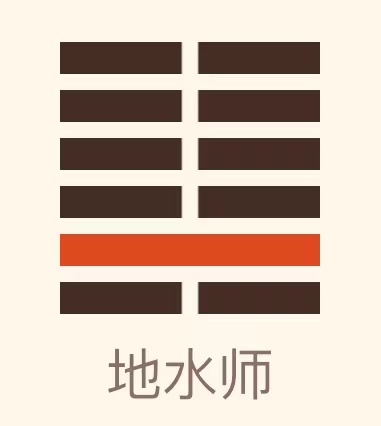
The first line (Chu Liu) of Hexagram Shi (The Army) marks the beginning of the hexagram. Its line statement reads:
“When the army sets out, discipline is essential. Without discipline, there is misfortune.”
Below is the analysis in three parts: interpretation, symbolic logic, and practical implications.
1. Interpretation of the Line Statement
-
“When the army sets out, discipline is essential”
- “The army” symbolizes organized collective action (e.g., military, teams, or large-scale endeavors). “Discipline” refers to rules, order, and structured governance. This emphasizes that any collective endeavor must prioritize discipline as its foundation.
- “Sets out” signifies the initial phase of action, aligning with the progression from Hexagram 6 (Conflict) to Hexagram 7 (The Army) in the Sequence of the Hexagrams: unresolved disputes may escalate, requiring organized intervention.
-
“Without discipline, there is misfortune”
- “Without discipline” (否臧, pǐ zāng) implies negligence of rules or poor leadership. Failure to enforce order or adopt sound strategies inevitably leads to danger or failure.
- The Xiang Zhuan (Commentary on the Images) adds: “Misfortune arises from the absence of discipline,” directly linking disorder to catastrophic outcomes.
2. Symbolic and Numerical Logic
-
Hexagram Structure
- Hexagram Shi comprises Kan (Water) below and Kun (Earth) above, symbolizing “water hidden within the earth.” Kan represents danger, and Kun signifies the masses, implying latent turmoil within a group that requires disciplined action to harmonize collective energy.
- As the first line of the lower Kan trigram, Chu Liu lies at the threshold of potential chaos, highlighting the need for discipline to control emerging risks.
-
Line Transformation
- If Chu Liu (a yin line) transforms into a yang line, the lower trigram changes from Kan (Water) to Dui (Lake). Stagnant water symbolizes hindered progress due to lax discipline.
3. Practical Implications
-
Leadership and Organization
- For teams or military campaigns, clear rules and hierarchies must be established. Leaders must exemplify discipline to maintain authority.
- Neglecting order (“without discipline”) leads to failure, even with abundant resources.
-
Personal Decision-Making
- When undertaking significant actions (e.g., investments, partnerships), predefine rules and strategies (“plan meticulously at the outset”) to avoid impulsiveness.
- The line warns: Minor oversights in the initial phase can trigger cascading risks.
Conclusion
The first line of Shi underscores that discipline is the primary safeguard against collective risk. Its warning of “misfortune” does not discourage action but stresses the necessity of rules and preparation, resonating with the I Ching’s broader philosophy of “prudence in beginnings.”