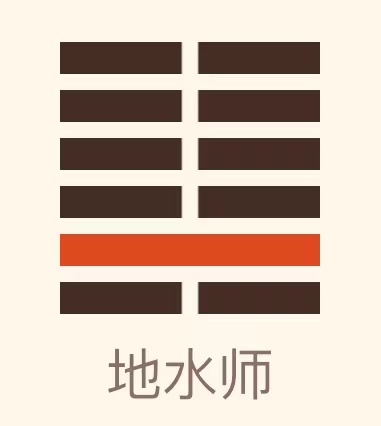
Line Statement: “The commander remains at the center of the army: good fortune, no blame; the king thrice grants mandates.”
1. Interpretation of the Line Statement
-
“The commander remains at the center of the army: good fortune”
- “At the center of the army” signifies the commander’s position of leadership, adhering to the Mean (central equilibrium) to balance authority and flexibility, ensuring both strategy and execution align with the greater good.
- “Good fortune” arises because Jiu Er, a yang line in the central position of the lower trigram (Kan/Water), symbolizes strength tempered by wisdom. The Xiang Zhuan (Image Commentary) adds: “Heaven’s favor shines upon him,” highlighting the commander’s alignment with the ruler (Sixth Five, the yin line above), representing divine mandate and trust.
-
“No blame”
- A just and disciplined commander avoids disaster even in perilous situations. For example, Duke Zhao Hu during King Xuan of Zhou’s reign faced slander but retained trust through integrity, eventually quelling rebellion.
-
“The king thrice grants mandates”
- “Thrice grants mandates” symbolizes the ruler’s repeated rewards, affirming the commander’s loyalty and competence.
- The Tuan Zhuan (Commentary on the Hexagram) states: “To embrace all states under heaven,” emphasizing that the commander must prioritize national unity and public goodwill to earn royal trust.
2. Symbolic and Numerical Logic
-
Hexagram Structure
- Hexagram Shi combines Kan (Water ☵) below and Kun (Earth ☷) above. Jiu Er, as the central yang line in Kan, embodies resoluteness tempered by adaptability.
- Its correspondence with Six-Five (the ruler) reflects “firmness centered and responsive,” ensuring military actions align with political objectives.
-
Line Characteristics
- As a yang line in a yin position (second line), Jiu Er must balance assertiveness with humility to avoid autocracy.
- If transformed into a yin line, Kan becomes Kun (Earth), symbolizing loss of leadership and chaotic decision-making.
3. Practical Implications
-
Leadership Essentials
- Holistic Vision: Prioritize collective goals over personal gain, as in “embracing all states.”
- Trust and Discipline: Maintain loyalty to superiors while enforcing order among subordinates.
-
Personal Growth
- In professional settings, impartiality (“remaining at the center”) shields against factional conflicts and fosters advancement.
- Resolve disputes by balancing competing interests through the “Middle Way.”
-
Risk Awareness
- Overreliance on royal favor without merit (e.g., mandates granted through nepotism) risks eventual downfall.
Conclusion
Jiu Er reveals that the path of centrality and integrity is vital for leaders:
- Externally: Balance authority and empathy to unite followers.
- Internally: Cultivate fairness and discipline to sustain morale.
This aligns with the I Ching’s emphasis on “leading through virtue” and underscores Shi Hexagram’s theme of “righteous collective action.”