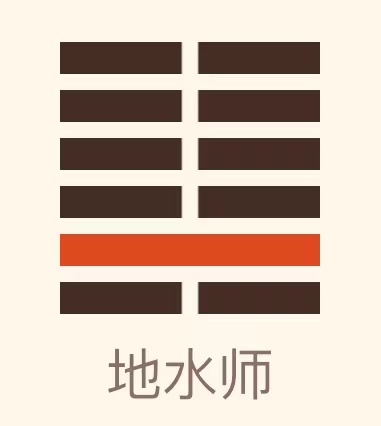
Original Line: 师左次,无咎。
Translation: The army retreats to the left flank; no blame.
⚖️ Symbolism & Position Analysis
-
Yin Line in Yin Position (六四):
- Proper Alignment: Softness (yin) in a soft position (4th line), signifying appropriate restraint.
- Upper Trigram Context: Located at the base of Kun (Earth ☷), embodying receptivity and strategic yielding.
-
Relationships:
- No Resonance Below: No support from Line 1 (both yin → no attraction).
- Proximity to Ruler (六五): Tactical withdrawal preserves strength to serve higher authority.
💡 Core Meanings
1. Strategic Retreat, Not Defeat
- “Retreat to the left flank”: In ancient Chinese military doctrine, “left” symbolized secondary positions or tactical withdrawal (right was favored for offense).
- Wisdom in Withdrawal: Avoiding direct confrontation when outmatched prevents annihilation. Example: “Evading the enemy’s sharp edge” (避其锋芒).
2. Leadership Principle: Prudent Restraint
- Key Action: Withdraw to conserve resources, reassess strategy, and await favorable conditions.
- “No blame” (无咎): Justified retreat incurs no moral or strategic fault.
3. Universal Application
- Governance/Management: Halt unviable projects; stabilize before advancing.
- Personal Growth: Exit draining situations (e.g., toxic jobs) to redirect energy.
🔄 Contrast with Adjacent Lines
- vs. Third Line (六三: “Carrying corpses”):
- Failure from rashness (六三) ↔ Preservation from retreat (六四).
- vs. Fifth Line (六五: Commanding authority):
- Withdrawal (六四) enables later victory under sovereign leadership (六五).
💎 Essence of the Line
“Retreat is wisdom, not weakness. Yield to survive, recalibrate, and return stronger.”
Applies to conflict resolution, business pivots, and personal transformations.
Translation Notes:
- “左次” → “retreat to the left flank”: Clarifies cultural metaphor (left = defensive/repositioning).
- “无咎” → “no blame”: Standard I Ching phrasing for justified actions.
- “坤德” (Earth’s virtue) → “receptivity of Earth”: Embodies yielding as strategic strength.