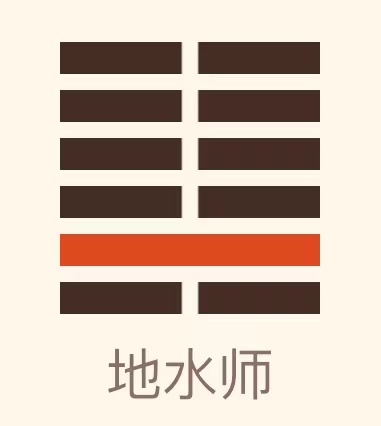
The Shi Gua (师卦) is the seventh hexagram in the I Ching (64 hexagrams), symbolizing an army or the gathering of people. Its core themes revolve around warfare, decision-making, and wisdom in leadership. Below is a detailed analysis of the fifth line (六五爻), based on classical interpretations:
1. Original Line Text
- 六五: 田有禽,利执言,无咎;长子帅师,弟子舆尸,贞凶。
This line divides into two scenarios: the first half describes justified action, while the second warns of consequences from poor leadership.
2. Interpretation
- “田有禽,利执言,无咎” (Tián yǒu qín, lì zhí yán, wú jiù)
- “Tián yǒu qín”: Wild beasts invade the fields (symbolizing external threats or conflicts), necessitating action.
- “Lì zhí yán”: It is wise to justify actions (e.g., declaring righteous motives) or make decisive moves to gain support.
- “Wú jiù”: If actions are grounded in justice, not aggression, there will be no blame. This echoes the hexagram’s emphasis on “righteous warfare.”
- “长子帅师,弟子舆尸,贞凶” (Zhǎng zǐ shuài shī, dì zǐ yú shī, zhēn xiōng)
- “Zhǎng zǐ shuài shī”: Appoint a virtuous and capable leader (symbolized by the strong Nine in the second line) to command the army; victory follows.
- “Dì zǐ yú shī”: If incompetent opportunists (symbolized by the weak Six in the third line) interfere, defeat ensues; “yú shī” depicts carrying corpses from the battlefield.
- “Zhēn xiōng”: Even with pure intentions (zhēn), poor leadership leads to disaster (xiōng).
3. Position and Symbolism
- As a yielding line (阴爻) in the sovereign’s position (第五爻), the ruler must rely on wise ministers for support.
- In the hexagram’s structure (䷆, Earth over Water), this line marks the war’s later stage: the ruler must decide whether to continue. “Tián yǒu qín” hints at stopping after achieving goals, while the second half warns against reckless expansion.
- Its correspondence with the Nine in the second line (the commander) highlights the ruler-commander synergy. Mismanagement (e.g., appointing fools) guarantees failure.
4. Core Lessons
- Decision-Making: Justify actions (“利执言”) and avoid unnecessary conflict.
- Wisdom in Leadership: Success depends on appointing the capable (“长子”); failure stems from incompetents (“弟子”). Authority must be centralized and merit-based.
- Warning: Even righteous goals (“贞”) collapse under poor execution, leading to ruin (“凶”).
5. Modern Application
- Leadership/Team Management:
- Address crises with justified, decisive action (“利执言”) to neutralize risks (“无咎”).
- Strictly vet talent; never let the unqualified handle critical tasks, or internal chaos follows.
- Relevance: In business, appoint experts (“长子”), not nepotistic hires (“弟子”), to ensure success.
This line uses war as a metaphor, revealing the balance between prudence in conflict and wisdom in appointments: justice as the foundation, competence as the safeguard, recklessness as the path to ruin.